Crop Sessions in NYC
Crop
An extension of the body. The implement I've held the longest.
Crop, explained
You've probably pictured the riding crop in a Dominatrix's hand, the long line of leather that almost never strikes. Most people assume the crop is the mild starter implement, the polite cousin of the cane and the paddle. It isn't mild. It's the most precise tool I keep in the studio.
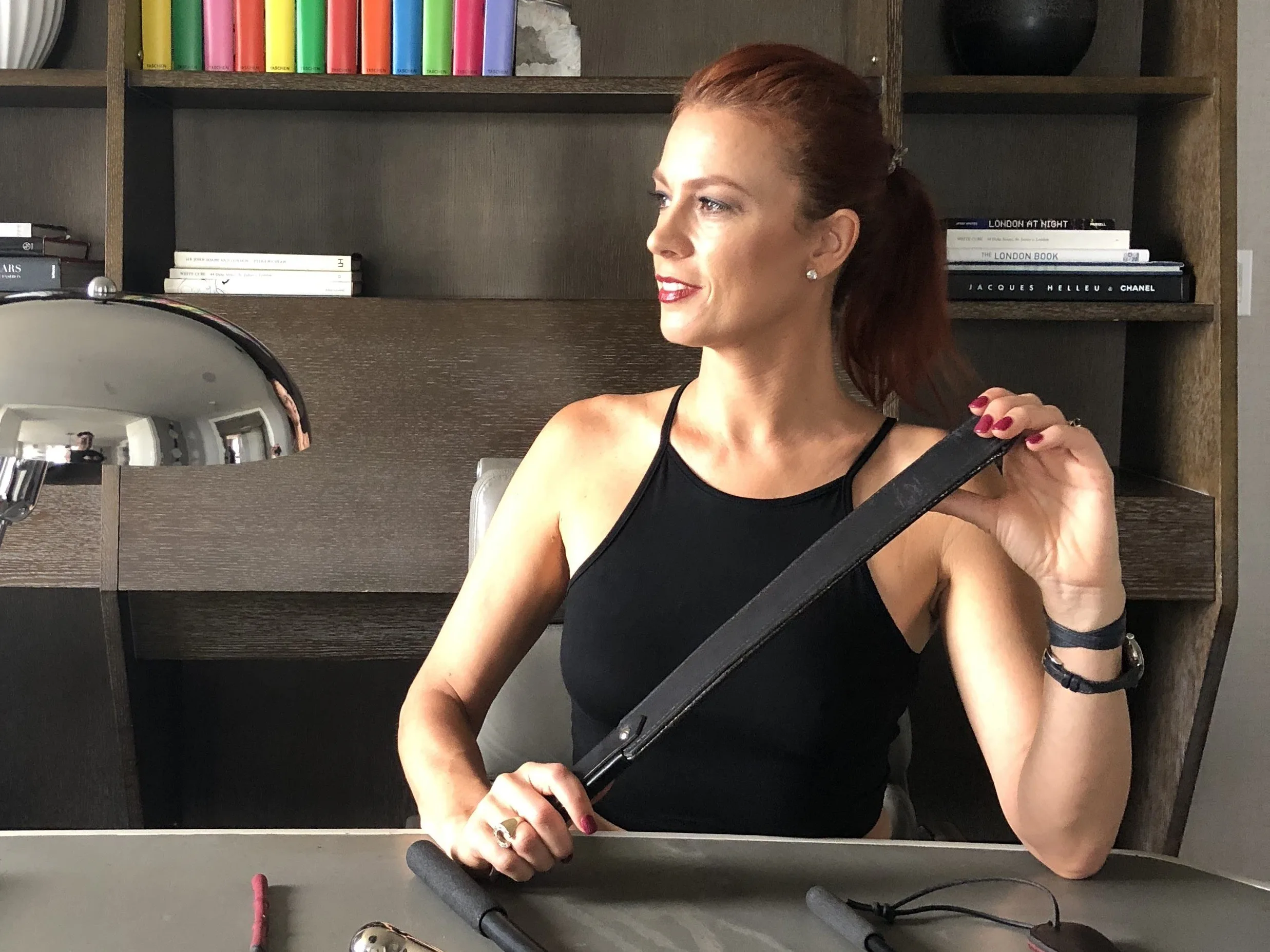
In Manhattan, NYC Dominatrix Viktoria Sway works the crop differently than most. The crop has been in my hand my whole life. I ride horses. The crop is part of how I move through the world, how I communicate with an animal far larger than I am, how I direct attention and apply pressure with the smallest amount of force needed. By the time I picked up a crop in a kink context, I had been holding one for years. It's the implement I know best, more than the flogger, the paddle, or the whip, and a crop session with me is doing something specifically informed by that history. The crop, in my hand, is not a generic Dominatrix prop. It's an extension of my body.
The crop is part of impact play, the family of practices where tension and tone determine what the strike means. It also sits inside BDSM in NYC more broadly, where the same principles of negotiation, register, and presence apply. The crop is true to the spine of impact play, and it also sits a little outside the rest of the impact family, its origin and its register both make it different from the implements next to it on the page.
The equestrian origin
A riding crop is a tool of communication. In horse work, it doesn't deliver pain. It delivers a precise, light tap that asks the animal to do something, move forward, pay attention, respond to a leg cue. The point of the crop is direction, not sensation. The point is the smallest stimulus that produces the right response.
That's the same instinct I bring to the crop in kink. The crop in my hand is a directing tool. Where to look. Where to feel. Where to hold position. The strike isn't the point. The cue is the point. The crop tells the body what to do and the body, if it's listening, does it.
This is a different posture than I bring to the heavier impact tools. With a flogger, I'm working sensation. With a paddle, I'm working narrative. With a cane, I'm working precision and adrenaline. With a crop, I'm working attention, and the strike is just the punctuation.
Who the crop is for
People drawn to scenes where direction matters more than intensity. People who want a top who is reading them and instructing them, not just hitting them. Service-oriented bottoms, the crop is the implement of service in a way no other impact tool is. Training scenes. Posture work. Scenes where holding still, holding position, holding eye contact (or not) is part of what's being asked. The crop is the implement that fits a scene built around posture, position, and direction.
It's also a good entry-level impact tool for bottoms who want to start somewhere and aren't sure what they want yet. The crop is small enough, controllable enough, and culturally readable enough, most people have an immediate intuition about what a crop is, that it serves as a soft introduction to impact without requiring the bottom to commit to a heavier implement.
What the crop actually does
Three things, primarily.
It directs
The crop tip can tap, lift, point, hold a position. I can use the crop as a chin-lifter, a posture corrector, a "look here" instrument. Long before the crop strikes anything, it's already directing.
It signals
A light tap with the crop is unmistakable, and the bottom can read it across the room. The crop lets me give a clear instruction with the smallest possible action. This is part of why it works so well in scenes that have a service or training register.
It strikes
When the crop does deliver impact, it delivers a sharp, contained sting on a small zone. The contact point is narrow, about the size of a thumbprint, and the strike is fast. It's closer in feel to a cane than to a paddle, but lighter, and with a different cultural weight.
The Tensions and Tones the crop carries
The crop's range is narrower than most of the other impact tools, and that's worth saying instead of pretending the implement is everything to everyone.
Tones the crop lives in. Strict / Discipline, the crop is the natural implement of correction, training, and earned approval. Devotion / Ritual, the crop in service is one of the most ritual-feeling implements, because the directing function turns the scene into something close to choreography. Forbidden and Humiliation / Degradation can sit inside a crop scene, particularly in training scenes where the bottom is being walked through behavior that exposes them. The crop does not sit naturally in Sensual (it's too sharp), Play (the implement carries more weight than play implies), or in heavy High Intensity scenes (a crop can't carry sustained intensity the way a cane or whip can, it doesn't have the mass).
Tensions the crop carries. Anticipation, the implement's smallness and precision means the bottom is always reading where it might next land. Time Pressure, crops live well in scenes with rules and counts. Push/Pull, the directing register asks the bottom to resist or comply in real time: hold the position, take the next instruction, or break the pose on purpose. The crop is the instrument that registers each choice.
Map your own pattern
Find out which Tensions and Tones light you up, the crop is one of many implements that shape them.
Take the BDSM Blueprint Quiz →How the crop fits into a session
The crop is unusual because it isn't really part of the impact build. Hand → flogger → paddle → cane → whip is the impact progression I use for most scenes. The crop sits outside that progression and runs alongside it. I might have a crop in my hand for the entire scene, using it to direct, to point, to correct posture, while I'm also working other implements. Or I might run a session built almost entirely around the crop, particularly with bottoms drawn to service and training registers.
In a posture-and-presence scene, the crop comes out before you do, I might walk in with it already in my hand, use it to lift your chin into the position I want, hold the line of your shoulders with light taps, and let the strike, when it comes, be a punctuation mark inside an hour of being directed. A horse rider doesn't put down the crop; in session, the crop in my hand functions the same way, present throughout, used when the moment asks for it, sometimes barely used at all and yet still doing something just by being there.
BDSM classes in NYC
Going deeper
The crop pairs naturally with service and with the training register more broadly, a directed, ritualized scene built around correction, posture, and earned approval. The wider hub for these dynamics is BDSM in NYC, which gathers the practices the crop sits alongside.
If you want to think more carefully about which Tensions and Tones light you up, the BDSM Blueprint class teaches the framework directly. For couples bringing direction and training into a relationship, Blueprint for Couples covers the same territory in a partnered frame.
Explore More