
Conscious Kink Sessions in NYC
Conscious Kink
BDSM with the lights on.
Conscious Kink: The Somatic Experience of BDSM
Your body talks when you play. Heat in your face when the humiliating thing is finally said out loud. The drop in your stomach when the rope pulls tight. The flood of relief when you stop deciding and let yourself be moved. Fear and excitement running so close together you cannot tell them apart. Most play rushes past these moments on the way to the next activity.
Conscious kink slows down and feels them.
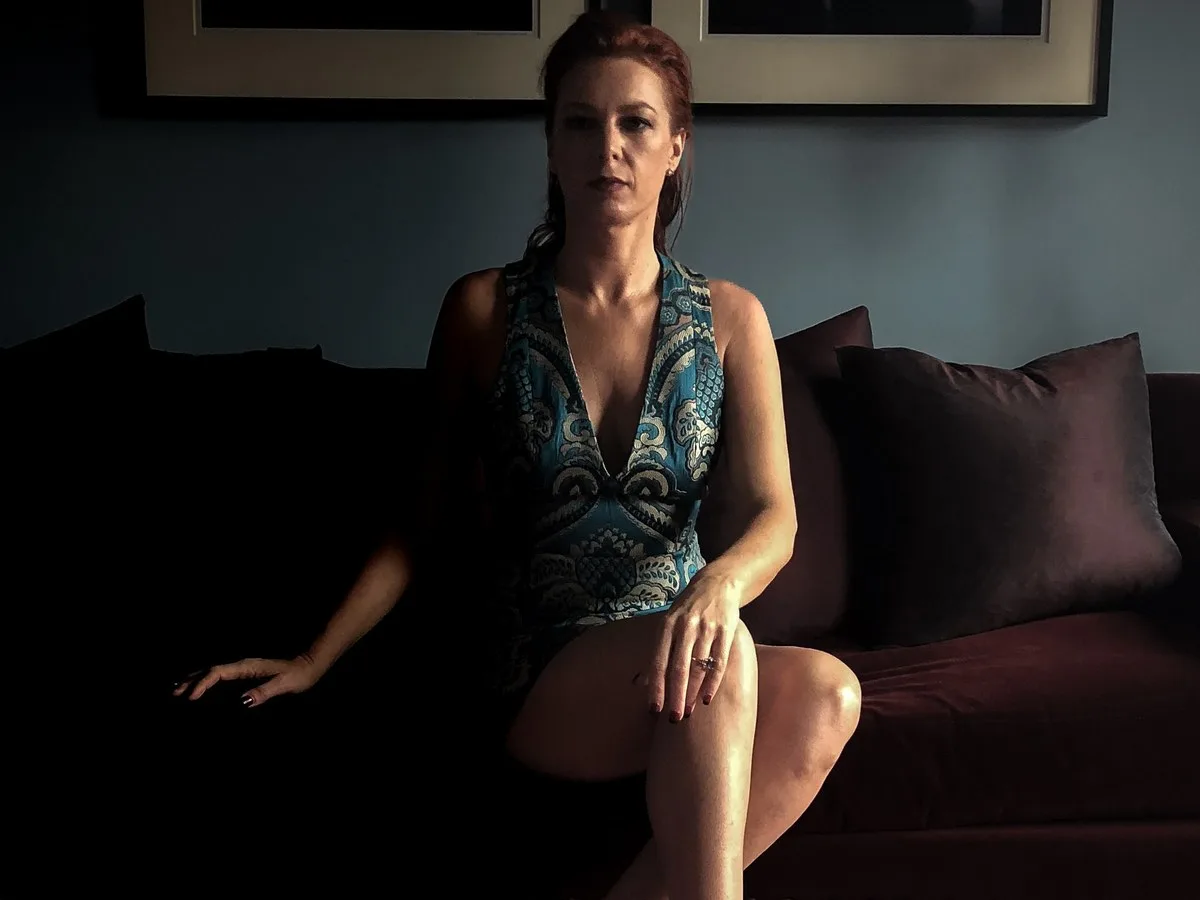
I'm Goddess Viktoria Sway, a Dominatrix in Manhattan, and this is what I reach for in every experience I offer: pegging, humiliation, bondage, service, CNC, the whole map of BDSM in NYC. The activity changes. The aspiration does not. Notice what your body is feeling while you play, the fear, the excitement, the humiliation, the wanting, and the scene reaches further.
What Conscious Kink Is
Conscious kink is BDSM practiced with attention to what is being felt and what is being reached for.
Not a methodology. Not a system layered on top of your kink. A quality of attention, and a set of skills that get sharper over time. The scene from the outside might look like any other scene. What is different is what is happening inside it, for you, for me, for both of us, and how much of it is felt.
What It Gives You
Magnification. The same act, felt more fully. The same fantasy, met more directly. The intensity you came in for, larger, because more of you is present to feel it.
Recognition. Your desire becomes legible to you. The kinks you reach for stop being random preferences and start making sense as a pattern that is yours, that means something, that can be followed further.
Less self-attack. Kink without the after-shame loop, without the morning-after recoil. The conscious version does not require you to make peace with your wanting before you arrive, but it tends to leave you in less of a fight with it on the way out.
Range. Contact with parts of yourself that everyday life keeps quiet, hunger, ferocity, smallness, tenderness, dominance, surrender, without those parts taking over. You touch them inside the scene. You bring back what you want.
Freedom. What you meet in a scene is true in the moment. It does not have to follow you out as a label. You can feel your ferocity without becoming a cruel person, your smallness without becoming a weak one. You learn what part of you is there and what it wants, without becoming it.
Repeatability. A scene played with attention can be repeated as many times as it asks to be repeated, and not go stale. Each time, more of what it is reaching for arrives. The charge does not flatten because you understand the scene better... it deepens. The play that used to feel like it was wearing thin starts to open instead.
Conscious Kink and the Other Way of Playing
There is another way to play, and it is not lesser. Kink as escape, kink as fun, kink as the body running on its own appetite without anyone asking why - that has its own pleasures, and they are real. Sometimes that is exactly what a scene is for. Some of the best play in your life will be that kind of play.
Conscious kink is what you reach for when you want to feel more of what is already there. Not a different activity. A different aim. You can move between the two, most experienced players do, and you can feel which one a particular scene is asking for, once you know how to listen.
This page is about the conscious version. Not because it is better. Because it is the one that does not get written about clearly very often.
What "Underneath" Means
When a particular scene, role, or dynamic keeps drawing you back, when you find yourself reaching for the same thing across years and partners, your body is asking something. The activity is one expression of the asking. The thing it is asking for is what is underneath.
Erotic patterning is intelligible. It is not random, it is not pathological, it has a shape, and the shape can be read. Most kinks are reaching for something specific, to be seen in a part of yourself that has been hidden, to be claimed by something larger than your own will, to feel a particular kind of charge run through you that ordinary life will not produce. Once the asking is named, the scene gets to answer it directly instead of circling around it.
Charge is the reason kink can reach what conversation cannot. Erotic charge brings material forward, the arousal loosens what the ordinary self keeps filed away, and what surfaces in a charged scene is often more honest than anything you could say about yourself in plain daylight.
This is most of what I mean when I talk about working with what is underneath. Not therapy. Not analysis. A scene that knows what it is for.
Conscious Kink and Shadow Play
Shadow play is conscious kink turned toward material that has been buried, the parts of yourself you have kept underground because they did not seem allowable, or did not seem yours, or got named as wrong somewhere along the way and never came back into the light.
Not all conscious kink is shadow play. Some of it meets joy, vitality, hunger to be seen, hunger to claim, parts you have also kept quiet, that are not dark, that simply have not had room. Shadow play is one application of the wider posture. The wider posture is conscious kink itself: attention to what is moving, regardless of which part of you is moving it.
Polarity, Chemistry Built on Purpose
Two people in a room is not a scene. A scene is two people in deliberately chosen poles, leaning into the difference between them.
Top and bottom. Owner and property. Predator and prey. Teacher and student. Sadist and masochist. Dominant and submissive. The mechanic is the same in every case: clearly differentiated roles, both players leaning into their pole, charge generated by the difference between them.
Conscious kink reads which polarity the moment is asking for and leans into it on purpose. It does not default to whichever pair the players happened to start with. It does not soften the polarity to be agreeable. It sharpens the difference, because the difference is where the charge lives. A scene with vague poles is a scene with a vague charge. A scene with poles you have chosen and committed to is a scene that has somewhere to go.
This is craft, not metaphysics. Polarity in conscious kink does not require any claim about masculine and feminine essence, sacred geometry, or energy fields. It requires you to know what role you are in, what role your partner is in, and how to lean.
There is a second reason the poles matter, beyond charge. What surfaces when a real person is holding the other pole is different from anything a private fantasy can produce. In fantasy you control both sides. In a scene you only control your own, and the difference is where the honest material shows up. Being in relation exposes. BDSM gives that exposure shape.
Shame, What to Do When It Shows Up
Shame surfaces in scene. Not always, but often, and especially when the scene is reaching something the conscious self has spent a long time not looking at. It can arrive as heat in the face, a sudden urge to apologize, a flicker of wanting to disappear, a feeling that what you just did or said or wanted has revealed too much.
Conscious kink does not run from this. It also does not double down on it. It notices shame as it shows up, gets curious about what it is attached to, and lets attention do the processing instead of avoidance. Shame loses some of its grip when it is met directly. It loses the rest of its grip slowly, scene after scene, as the part of you it was protecting stops needing the protection.
This is also what is happening, in a sharper form, in good humiliation play. The conscious version of humiliation is not shame avoidance and it is not shame reinforcement. It is shame met in the open, with someone paying attention, where the degradation happens inside a relationship that is explicitly the opposite of degrading, and the part of you that has carried the shame gets to feel it in a context that does not confirm it. Done with attention, it loosens. Done without attention, it tightens.
Shame is one binding force around the material conscious kink reaches. Not the only one, fear, disgust, and confusion bind it too, but the most common, and the one most worth knowing how to meet.
Surrender and Collapse
Surrender is what you are reaching for when you let go. Collapse is what people sometimes get instead.
The two can look identical from outside. From inside they are nothing alike. In surrender, awareness widens. More of the body is present, more of the moment comes through, more of the partner is felt. The submissive, or whichever player is in the receiving pole in a given moment, yields, and is more present in the yielding than they were before. In collapse, awareness narrows or disappears. The body is in the scene, the person is not. The submissive checks out, fragments, hands their attention to a place that cannot hold it. They wake up later more tangled than they started.
You can feel the difference, once you know to look. A surrendered submissive tracks the room with their breath even when their eyes are closed. A collapsed one is somewhere else. A surrendered submissive comes back present, lit, integrated. A collapsed one comes back disoriented, scrambled, missing pieces.
Conscious kink is built to support surrender and to refuse collapse. The negotiation, the pacing, the noticing, the close of the scene - these are not safety theater. They are what makes the going-under voluntary instead of dissociative. If you have left scenes feeling more lost than you went in, the issue is almost never the intensity. It is whether anyone in the room was paying attention to which one was happening.
Permission gives the act space. Witnessing gives the act meaning.
Witnessing and Permission
Most kink writing teaches the language of permission. I give you permission to want this. I give you permission to be this in the scene. Permission is doing something real, it pushes against the cultural training that names certain wanting as wrong. It gives the act space.
But permission is not the deepest move.
Witnessing says: I see what you are doing, what you are reaching for, what is moving in you while you do it. I do not look away. I do not flinch. I do not collapse under the weight of what you are showing me.
Most of what surfaces in conscious play is not asking for approval. It is asking for reception. The submissive does not need to be told humiliation is okay; they have already chosen the scene. What they need is for someone to be present with them while they are in it, to see what is happening, to remain unbroken by what they are willing to show.
That reception is what makes integration possible. A part of you that has been seen by someone who did not flinch does not have to go back into hiding. It becomes something you can carry consciously, in the scene and after it.
Attention Is the Skill
None of this is mystical. None of it is therapy. It is craft, and it is learnable.
The skills are specific. Noticing what is moving in the room, in your body, in your partner's, in the charge between you. Naming it without breaking the scene. Staying with it without flinching when it shifts. Knowing when to redirect and when to hold. Closing scenes deliberately, so what surfaced gets to stay surfaced rather than rattle around loose.
These are not difficult skills. They are precise ones. Some scenes ask more of them than others. The longer you practice, the more of them you have available, and the more your scenes can reach.
Tensions, Tones, and Zings, How Attention Becomes Specific
Conscious kink is not vague presence. It is specific attention, and specificity needs language.
Every scene is built on a Tension that gives it its charge: Anticipation, Denial, Push and Pull, Unpredictability, Time Pressure, High Intensity. Every scene runs in a Tone that shapes its meaning: Play, Sensual, Devotion, Strict and Discipline, Forbidden, Humiliation. The same activity in a different Tone is a different scene. A spanking inside Devotion is not the same scene as a spanking inside Humiliation, even when the strikes are identical.
Most unconscious play defaults to whichever combination got learned first and runs that combination regardless of what the moment is asking. Conscious kink reads the room. It notices that today the same activity wants Anticipation instead of High Intensity, or Devotion instead of Forbidden, and lets the scene shift accordingly.
A scene that does not know which Tension and Tone it is in is a scene running on autopilot, no matter how technically skilled the players are.
Map your own pattern
Which combinations make scenes work for you, and which leave you flat?
Take the BDSM Blueprint Quiz →BDSM classes in NYC
How I Work With This in Session
I do not lead a scene I cannot read.
What this means in practice: I notice what is happening as the scene unfolds, and I will say it out loud when it matters. Something just moved. What is that? From there we either follow it, redirect, or pause to renegotiate, depending on what is alive in the room. I close scenes deliberately. I do not leave clients in altered states without a clear return to ordinary consciousness.
This is not therapy. Therapy is a different practice with different aims and a different relationship. Conscious kink is BDSM that knows what it is doing. The two share concerns, what gets surfaced, what gets witnessed, what gets integrated, but they are not interchangeable, and I do not pretend to offer one when I am offering the other.
The clients I go deepest with arrive curious about the underneath. They do not need to be articulate about it. Most are not, at first. They can sense that what they do in a scene is less interesting than what the scene lets them finally feel. The conscious version is what they came for, even if they did not have language for it walking in.
Going Deeper
A session is one container. The longer-form practice happens across more time than a single meeting allows: recognizing your own patterns, learning to read what your scenes are reaching for, building the skill to design conscious play with anyone you partner with.
BDSM Blueprint, the entry class in my Foundations tier, teaches the framework, Tensions, Tones, and Zings, with enough specificity to map your own pattern and read someone else's.
The Hidden Logic of Desire is about why you crave what you crave. Pattern recognition underneath recurring attractions. Conscious kink turned inward.
Taboo: The Workshop goes at the shadow material. Shame, the parts you have called wrong, and what owning them means in practice.
For the wider map of related topics, see the BDSM in NYC overview. For people who want to take this into longer-form one-on-one development, I also offer coaching.
The aim of conscious kink is not to make every scene a therapy session. It is to make every scene know what it is doing. The intensity stays. The play stays. What changes is what you get to keep: less fighting with your own wanting, and more contact with the full range of what you can feel. That is what the practice is for.
Explore More
BDSM Shadow Play
Shadow play uses BDSM to meet the parts of you ordinary life will not let you become.

Consensual Non-Consent
CNC is not the absence of consent... it is the most extensive consent architecture in BDSM.

Humiliation & Degradation
Ego-stripping with architecture. The psychology of being brought low, and who it actually serves.